Showing posts with label Denyse Kritschgau. Show all posts

Sunday, February 21, 2016

Week 7: Who is Using and Paying for What?

This week’s readings made me feel ADHD. 

I really applied myself to the readings, starting earlier in the week than usual, and doing ancillary research.  Because I had chosen this topic for my first case study, I needed to really understand and make connections. And I needed to find something interesting to use for my case study.  Initially, that seemed nearly impossible.  After delving deeper into the readings; however, I’m completely fascinated and passionate about the economics of digital media.

My initial point of interest was in the possibility that print news wasn’t dead.  I liked the idea, maybe it was the nostalgia associated with it.  I remember my grandmother sending my copies of our local paper, the Cameron County Echo, while I was stationed in Japan.  We never had news with a global impact, not did the Echo report on it.  But we had the best local interest stories.  I remembered being mocked by my fellow sailors over my favorite headline ever, “Stumpy’s Ice Cream Cart Demolished.”  That news, a crushing blow to a country girl who cherished that cart, was fodder for endless jokes and required lots of explaining.  Who was Stumpy?  Why was he called Stumpy?  Why an ice cream cart and not a truck?  How was it demolished?  Why did its destruction warrant front page coverage?  Even my urban friends were fascinated by this story.  

This is print news at its best to me.  And while online hometown stories might be more timely and accessible, I can’t cut them out and pin them to my cork board or put them in my scrapbook alongside postcards and magazine clippings.  After reading more about the future of print news, I actually realized that I had an opinion about their (potential) demise, where I previously had none.  Motivated in my newfound interest in print newspaper sustainability, I launched into my research.

“The Ramen Noodle Theory of Online News” was fascinating.  I was encouraged and intrigued with much of Professor Chyi had to say about the longevity of print media.  I was so encouraged and intrigued, in fact, that I highlighted topics to research further.  The first was Professor Clayton Christensen’s “Disruptive Innovation Theory.”  Here’s the graph:

Based on this theory, newspapers were led to believe that they should invest heavily in their online content.  After all, technology was becoming more and more accessible to the reading population.  Online news was clearly - based on this theory - going to outpace print news.  But an article by Steve Denning at forbes.com argues against this theory.   Citing a 2015 MIT Sloan School of Business study, he contends that the key to relevance in the digital space isn’t predicting and combatting competitors; the key lies in management and innovation.

Most managers, when faced with a disruptive innovation, simply give up.  2/5 of all managers in these types of situations simply “choose to die,” according to the Sloan study.  And, as the study further states, they were absolutely right in doing so.  They never stood a chance, in essence.  The Sloan scholars justify this harsh statement with the knowledge that, unless the companies in question were already capable of innovating to match the disruptive innovation, they SHOULD just give up.  Innovation under those circumstances was resource prohibitive.    

But with less than 5% of U.S. companies willing or able to innovate, according to the Sloan study findings, what options are businesses given?  They provide a solution less “heart-wrenching” than death:  outward thinking.  Denning proposes that company presidents should "stop running the company with defensive, inwardly-focused, hierarchical bureaucracy and commit to continuous customer-focused innovation.”  In other words, healthcare providers should focus on their patients; camera companies should focus on the quality of their photos; newspapers should focus on news.  But these industries (and many others) are so focused on revenue and CEO retirement packages that they have forgotten the essence of the product or service that catalyzed their businesses in the first place.  Re-committing themselves to their roots could very well prove to be their saviors.

If this theory holds true, newspapers will win the news delivery competition with a combination of innovation and dedication to their craft. While most major print sources have attempted to innovate with online sites and apps, they find themselves stymied by the lack of ad revenue.  It DOES take money to operate a site and pay reporters and send the news to press.  So paid ads on their online sites seem not only logical, but necessary.  But that’s not working so well.

Advertisers aren’t willing to pay for online ads as much as for print ads.  Print ads had come to be viewed by readers as necessary, but minor distractions.  Online ads are vastly different than the subtle suggestions represented by the 2” x 4” rectangle paid for by Sears on page 5 of the paper.  Online ads are glaring. And obtrusive. And annoying. And immune to any sort of privacy-while-web-surfing etiquette.  And therein lies the REAL problem facing newspapers and their advertisers: ad blockers.  

Michael Rosenwald of The Washington Post reported in Fall 2015 that nearly 198 million people globally use ad blocking software, which, when the article was published, was up 41% from 2014 numbers.  That percentage is even higher in the U.S., with almost 50% of our internet users employing ad blocking techniques.  Adobe, committed to aiding those businesses who are losing money to ad blocking, says that $21.8 billion in global ad revenue will be blocked this year.  They suggest that users are “inadvertently putting their favorite websites out of business."

Well, I hate online ads.  Passionately.  After reading about the most prominent and effective ad blockers, available at Adblockplus.org, I immediately installed it on my laptop.  Oddly, I had an article from Forbes.com  on my screen prior to the installation.  When I went  back  to access the article, the following appeared on my screen:  

QUOTE OFTHE DAY

“Pushing the limit isn’t always the way to succeed.”
Jimmie Johnson
We noticed you still have ad blocker enabled. By turning it off or whitelisting Forbes.com, you can continue to our site and receive the Forbes ad-lightexperience. 
Ha! Nice try Forbes!  There’s no way I’m having you whitelisted OR turning off my adblocker.  Maybe you’ll go out of business.  

PageFair, a Dublin-based anti-adblock startup that provides publishers with technology that measures and defeats adblockers, is equally passionate about ad revenue.  They have been working with prominent online sites to find ways around adblockers.  On October 31, 2015, The Economist’s online site - happily employing the services of PageFair - came under attack of a malware virus, seemingly planted by adblocker advocates.  Economist online readers on Halloween night (and readers of over 500 additional online sites) pick up this virus.  Ultimately, people want the right to block ads, some so much so that they’ll go to great lengths to ensure that ability.

Sunday, February 7, 2016

Week Five: Information Seeking, Polarization, and Digital Democracy

The Pew Research article concerning the role(s) of Twitter and Facebook play in their users' awareness of news didn't surprise me, although the onslaught of numbers certainly gave me pause.  To better understand those numbers (no malice to Pew Research - that's what they do), I actually followed another link that put the findings into a more digestible format for me:

http://www.journalism.org/2014/03/26/8-key-takeaways-about-social-media-and-news/

In this article, the Pew Research group drew 8 important conclusions about the role of Twitter and Facebook in news distribution.  Point #7 had the statistic that most piqued my interest:  "Facebook news consumers are more likely to be female than news consumers on YouTube, Twitter, and LinkedIn." 

A Huffington Post article explains this best:  http://www.huffingtonpost.com/2012/07/09/women-facebook-twitter-pinterest_n_1655164.html  Of course the number of Facebook news users is going to be predominately female; Facebook users in general are predominantly female.  (Incidentally, the number of Facebook employees is predominantly male:  http://www.huffingtonpost.com/2014/06/26/facebook-gender-diversity_n_5532868.html). 

I think that this important bit of information should have been part of the framing of the Pew Research study.  I didn't see any reference to the majority gender of Facebook (or Twitter) users in the study, making the data less relevant to me.  Maybe they should have included Reddit - with it's predominately male user base - in the study.

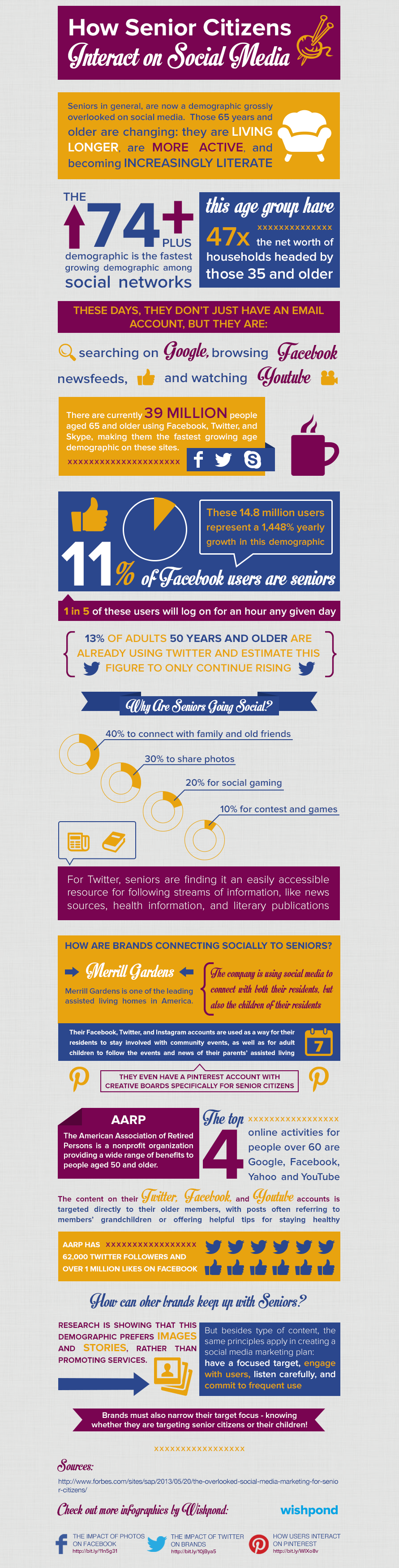
Another demographic I'd be interested in seeing is how senior citizens use social media.  I'm a big infographic fan:
In the breakdown for how seniors use social media, it doesn't mention news at all.  How does this impact the study?  Are only users <50 using social media for news?

I fall into the Twitter bucket for exposure to news. I do not; however, use Twitter as my sole source for information, rather more like a movie trailer.  An article I stumbled upon during this week's research called this sort of teaser a "pathway to news."  My personal procedure is to check Twitter at irregular intervals throughout the day, and when I see a reference to a news story that interests me, I go to a noteworthy news site and/or their corresponding app to get more information.  Then I feel as though I've done my due diligence in both assuring the veracity of the news and minimizing the amount of sensationalism that I engage in.

The article titled, "Facebook use polarizing? Site begs to differ" made me want to dust off my FB profile page.  I haven't been on Facebook in months. It depresses me.   Every single one of my 600 "friends" has either dramatically more exciting or more depressing lives than I do.  20 minutes on Facebook results in a thorough scrub of my mundane existence. Prior to reading this article, I used FB, solely as a way to keep in touch with my parents.  I honestly thought it was for the baby boomer generation to keep up with their children and grandchildren. Oddly, last week, as I was hosting an event at work, I noticed the UT Dallas student next to me checking Facebook at least as many times as I checked Twitter during the admittedly boring presentation.  That, along with the Pew Research data, turned my senior citizen theory on its ear.

As a mother of three, I've been (somewhat) guilty of protecting people's feelings.  But unlike many moms, I was in the Navy for 13 years, and my opinion during that tenure rarely mattered. "The U.S. Navy is NOT a democracy," I was repeatedly told.  The combination of maternal instinct and military service has made me a little more pragmatic.  It's not reasonable to expect everyone's opinion to be counted.  Why SHOULD I carefully tread around the opinon of someone who isn't qualified?  I likewise wouldn't expect my untrained opinion to matter in a discussion in an area I know little about - the books of the Bible, for example.  I think that opinions should be weighted by authority and experience rather than people's feelings.  That isn't to say that I don't believe in carefully couching the rejection statement or in the benefits of collaborative think sessions.  I just believe that participants should be self-actualized enough to realize know how relevant their voice is in a given group, and not be offended when they don't win the argument or find a compromise that takes their thoughts into consideration.  

Incidentally, I'm also not a fan of trophies for every team that participated in the pee wee football league.  You don't get an award for showing up at work as an adult.  You get awards for outstanding performance. 


Sunday, January 31, 2016

Week 4: Clash of Traditional and Emerging Values in Digital Journalism

Over the past few years, I (and just about everyone I know) have evolved into a social media junkie. I hadn't really analyzed what I drifted toward or what it indicated about my personal interests. Until I started my week four readings. Sadly, in the course of my evolution, I've detacheded myself from what can be viewed as "traditional" news (newspapers, magazines, evening news programs, and even having one of my car radio presets on NPR) and settled on more sensationalized news. And I've been ok with that.

After reading these articles, I did some ancillary research about speed-driven journalism, and discovered a panel from "Social Media Week" in NYC:  http://socialmediaweek.org/blog/2015/03/real-time-news-mobile-journalism/

As a "leading news platform and worldwide conference that curates and shares the best ideas and insights into social media and technology's impact on business, society, and culture," I thought they would add perspective to the readings.  The first panelist referenced the "llama story" from 2015.  I actually remembered this story, and felt pretty relevant as a result.  But, as the panelist pointed out, is that really news?  Are two happily freed llamas running around at will something I need to know about?  Probably not.

But those are the sorts of stories that populate my Twitter feed.  And my Tumblr, Instagram, Snapchat, Facebook, etc.  That's what I'm drawn to. (So sad!). When I read the article about Canada's CBS station covering the three shootings in Ottowa so beautifully, I was ashamed that I knew next to nothing of that story.  But I knew about the llamas!

So what constitutes news? And is news the same as current events?  And do current events and/or news trend on Twitter the same way that Kanye West does?  

The dictionary shows the following definition for news:

news1
—noun (usually used with a singular verb)
  1. a report of a recent event; intelligence; information: His family has had no news of his whereabouts for months.
  2. the presentation of a report on recent or newevents in a newspaper or other periodical or on radio or television. 
  3. such reports taken collectively; information reported: There's good news tonight.
  4. a person, thing, or event considered as a choice subject for journalistic treatment; newsworthymaterial. Compare copy (def 5). 
#4 intrigues me.  " ...event...considered as a choice subject for journalistic treatment."  That's completely relative and dependent upon the aim of the journalist.  As one article I found mentioned, the audience of the The Wall Street Journal is going to be interested in different "news" that that of People Magazine.  

Back to my Twitter feed.  I want to be a Wall Street Journal type of user, but the People stories are so much more interesting. My father-in-law's news is informative in a mind-expanding way.  Knowing who was responsible for the shootings in Ottowa and what motivated them demonstrates a greater level of social responsibility and global awareness - in short, a better citizen - than knowing about llamas does.  They don't expand my mind or enable me to carry on an intelligent conversation at a cocktail party, or even with my father-in-law.

So now that I've "followed" several reputable news organization on Twitter, I feel as though I'm being a more responsible citizen.

Sunday, January 24, 2016

Programmable Ethics

Last week in class, we discussed some different schools of thought regarding ethics and morals.  Because individuals hold their own ethical and moral codes, there are no absolutes.  The image I carried away from class was that of the person holding a knife, another person dead at his feet.  I immediately jumped to the conclusion that the knife guy murdered the dead guy.  I followed the classic Model 1 as outlined in the reading. What I lacked was information.  Could the knife holding guy have just picked the knife up, oblivious of the events that had unfolded?  Could he have just wrestled the knife away from now-dead-guy?  Or, supposing that he HAD killed the guy on the floor, could knife-guy have been acting in self-defense, or in defense of a loved one?  And would that make killing the suspect morally acceptable?  

People raised in the same culture, same community and even the same household, can have different moral codes and can react to last week's model differently.  This week's readings - largely focused on programmable ethics -  made me wish that there WERE a common moral code.  Honestly, I hadn't given much thought to self-driven cars prior to reading these articles.  It seems as though the over-arching guideline with regard to harming others is, "The basic intuition, known to philosophers as the doctrine of double effect, is that deliberately inflicting harm is wrong, even if it leads to good.  However, inflicting harm might be acceptable if it is not deliberate, but simply a consequence of doing good." (The Robot's Dilemma: Working out How to Build Ethical Robots is One of the Thorniest Challenges in Artifical Intelligence). This effect explains why most people wouldn't have sacrificed the perfectly healthy gentleman in the hospital to save the five dying from injuries in one of last week's examples.

I did some additional research (beyond what was assigned) and stumbled upon an article from Wired magazine, "Here's a Terrible Idea:  Robot Cars with Programmable Ethics."  The idea of programmable ethics blew my mind.  How could we possibly standardize ethics for robot cars, when we can't even come up with a standard set of ethics for humans?  The article contends that attempting to pre-program self-driving cars to react in certain scenarios would be virtually impossible.  We would have to identify every possible scenario and program every variable, to include possible number of passengers, their ages, the presence of animals, construction, road conditions.  The list is truly mind-boggling!

Another distinction that the Wired article makes is that, if the car were programmed to react a particular way to minimize damage - kill one person instead of five - that wouldn't change the fact that one person was dead.  And because it was programmed, that would mean the difference between manslaughter and homicide.  Who would be liable for that person's death?  The car company and it's programmers?  The owner of the self-driving car?  In attempting to identify and program for every scenario, we would be eliminating the very human (and often excusable) panic reaction.  Again, the difference between manslaughter and homicide.


In "The Ethical Dilemma of Self-Driving Cars," (Ted.com) Patrick Lin makes several salient points.  If a car were in an unavoidable crash scenario, where one option was to hit a person on a motorcycle wearing a helmet and the other was to hit someone on a motorcycle NOT wearing a helmet, what would the car do?  By hitting the person with the helmet - the one with the greatest chance of survival - that person would be penalized for following safety protocols.  But the converse exposes similar problems.

Sunday, January 17, 2016

Week One: Moral Philosophy and Why It Matters

The Meaning of "Culture"


Of this week's readings, this one initially piqued my interest the least.  I thought I had "culture" locked down. At first glance, it was going to be a level-setting reading for me, given that I (not entirely incorrectly) had vocally defined "culture" on the first day of class as a particular group's way of life.  While my definition was an accurate regurgitation of a portion of the dictionary entry on culture, it was myopic.  Rothman's article, with it's emphasis on culture's "unconscious groupthink" and "darker, sharper, more skeptical" aspects, helped me better understand culture in the context of this class.  Although he ended the article on a hopeful note, Rothman's gloomy definition stuck with me.  Clearly, I'm going to have to up my game.  Having lived in the largely whitewashed Frisco (where people get pulled over for having spinners on their cars) for the past ten years, culture defined as business practice or the occasional trip to the DMA will neither make me a relevant, contributing member of society nor a successful EMAC student.

Moral Media

My adult life has largely been defined by the influence of authority as a way of knowing.  From the time I graduated high school to when I took a job at UT Dallas, I have - for the most part - been employed by organizations that rely heavily on authority as a way of "fixing beliefs."  While most adults have had exposure to tenacity, intuition, and science as ways of knowing, I have not, at least not in a professional sense.  That's not to say that I don't also engage those additional methods, but my two longest-running tenures have been in the US Navy and in a non-denominational church.

Both the military and the church are clear examples of authority.  In the Navy, we were taught to obey
orders blindly.  The best we could do in the event we were given what we perceived as an "illegal order," was make the person in command aware of our hesitation to follow that order and state why
we thought is was illegal.  If the officer insisted, we were to execute the order as given and report it up the notorious "chain of command."  Failure to do so would result in corporal punishment under the UCMJ (Uniform Code of Military Justice).  As property of the US government, we obeyed orders, whether we found them to be ethical or not.

While I concede that following authority doesn't cultivate mental, moral maturity, it is necessary, particularly in the military. A junior enlisted on the field of battle doesn't have the experience and
tactical knowledge to question orders.  When tracking an enemy plane, steering an aircraft carrier, or flying a jet, blindly following orders may save lives.

Similarly, as an employee of the church, I was expected to believe that the Bible was the absolute inspired word of God.  As such, I didn't question its authority.  While there is an element of tenacity in the rules of the church, I feel the primary way of knowing is dictated by the authority of the Bible.  This isn't just a reference to God's law as handed down on stone tablets; it also includes the senior leadership's interpretation of that law and it's practical applications.

Ethics and Moral Reasoning

Largely due to the military service referenced above,  I tend to follow the precept that "the needs of the many outweigh the needs of the few."  The Moral Instincts section of this passage made me think twice about that pithy little saying. If that were always true, then the healthy man in the hospital waiting room would have to die to save the five who were critically injured in the first scenario.  The second scenario provided a more obvious solution.  Of course the unintentional killing of one person is better that the unintentional killing of five.  Ideally, no one would have to die.  But the second scenario differed in that a choice HAD to be made; one of the two groups was inevitably going to be eradicated (although I wondered if the train's horn was disabled along with the brakes).  It was a classic "lesser of two evils" scenario.  Most people wouldn't condone intentionally killing someone to save five.

I understand that these are "artificial dilemmas."  The real world example in the text quoting the National Guardsman who had to choose between saving a group of six or a family of two, made me wonder about the differences in the value of lives.  For example, what if the family of two were comprised of  two surgeons who could treat other victims? Would it be better to save those two than the six presumably non-surgeons?  Or would it be morally acceptable to save two young victims rather than six elderly ones?  After all, the elderly victims have already lived full lives.  I don't know the right answer or even if it's relevant.  But it seems to me that our society places different values on life based on demographics such as age, occupation, gender, etc.